News & Updates
Sniffing Out Cancer: Trained Dogs Can Detect Hemangiosarcoma by Scent
Tuesday, March 10, 2026
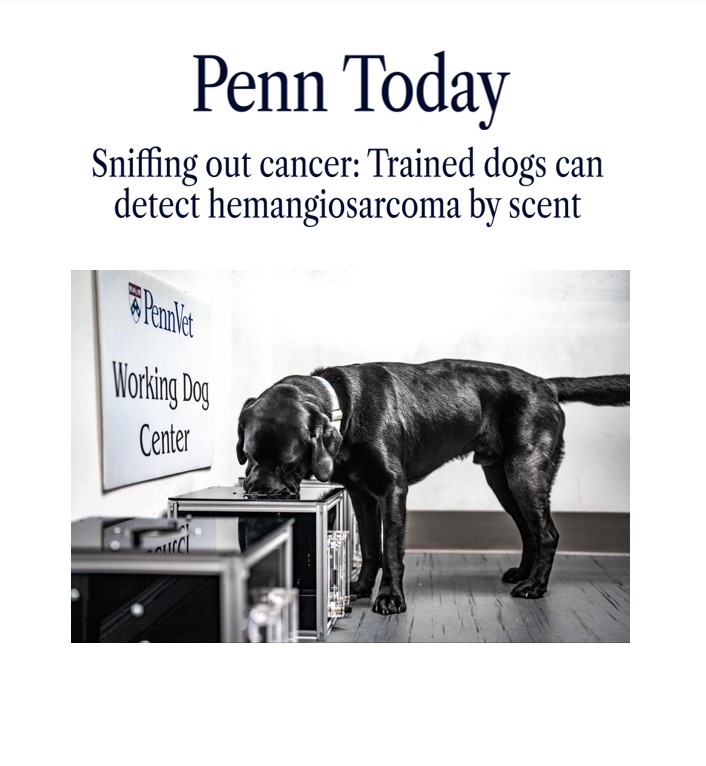
At Philly Fights Cancer, we’re proud to support groundbreaking discoveries happening at the University of Pennsylvania — and sometimes innovation comes with four legs and a powerful nose. Researchers at Penn’s School of Veterinary Medicine, led by Cynthia M. Otto and Clara Wilson, have shown that trained dogs can detect hemangiosarcoma — a fast-moving, often fatal cancer in dogs — simply by scent. Because this disease is usually discovered only after sudden collapse, early diagnosis has long been nearly impossible. By identifying unique odor signatures made of volatile organic compounds in blood samples, detection dogs correctly recognized cancer about 70% of the time, offering a promising first step toward a reliable screening tool.
Why does this matter beyond veterinary medicine? Cancer biology crosses species, and the ability to detect subtle molecular changes earlier is one of the most important frontiers in research. If scientists can translate these scent signatures into a machine-based test, veterinarians could screen dogs annually and intervene sooner — preventing spread, starting treatment earlier, and opening doors for clinical trials. Advances like this embody our mission: funding bold science that improves outcomes, accelerates therapies, and ultimately benefits both pets and people. Every breakthrough begins as a small signal — and sometimes, it takes a dog to help us smell the future of cancer detection.
Read more about these amazing discoveries here: Sniffing out cancer: Trained dogs can detect hemangiosarcoma by scent | Penn Today
Share this post




At Philly Fights Cancer, we’re proud to support groundbreaking discoveries happening at the University of Pennsylvania — and sometimes innovation comes with four legs and a powerful nose. Researchers at Penn’s School of Veterinary Medicine, led by Cynthia M. Otto and Clara Wilson, have shown that trained dogs can detect hemangiosarcoma — a fast-moving, often fatal cancer in dogs — simply by scent. Because this disease is usually discovered only after sudden collapse, early diagnosis has long been nearly impossible. By identifying unique odor signatures made of volatile organic compounds in blood samples, detection dogs correctly recognized cancer about 70% of the time, offering a promising first step toward a reliable screening tool.
Why does this matter beyond veterinary medicine? Cancer biology crosses species, and the ability to detect subtle molecular changes earlier is one of the most important frontiers in research. If scientists can translate these scent signatures into a machine-based test, veterinarians could screen dogs annually and intervene sooner — preventing spread, starting treatment earlier, and opening doors for clinical trials. Advances like this embody our mission: funding bold science that improves outcomes, accelerates therapies, and ultimately benefits both pets and people. Every breakthrough begins as a small signal — and sometimes, it takes a dog to help us smell the future of cancer detection.
Read more about these amazing discoveries here: Sniffing out cancer: Trained dogs can detect hemangiosarcoma by scent | Penn Today